Commercial Spray Painting
Shop fronts, restaurant facades and metal cladding, resprayed on site in the colour your brand calls for. Based in Nottingham, working across the East Midlands — and further afield when the job suits.
- 10-year guarantee
- 4.8 from 40+ Google reviews
- Hundreds of properties transformed
- RAMS and method statements
Respray it rather than replace it
Most commercial frontages do not fail. They fade, chalk, chip, or end up in the last occupant’s colours. Replacing aluminium framing, cladding panels or entrance doors to fix that means lead times, fitting crews and skips. Spraying them on site keeps everything that still works and changes the one thing that does not: the finish.
We spray in place with airless equipment, over surfaces that have been cleaned, keyed and primed where they need it. The result is an even coat with no brush or roller marks, in the exact colour on your brand guidelines — any RAL reference, a Farrow & Ball shade, or a corporate palette we match to a sample.
It is not the answer to everything, and we will say so at survey. A frame that has lost its seals, a door that no longer closes, or cladding that is holed through rather than faded needs repair or replacement first. Spraying makes sound surfaces look new. It does not make failing ones sound.
Recent work: a restaurant refurbishment in Warrington
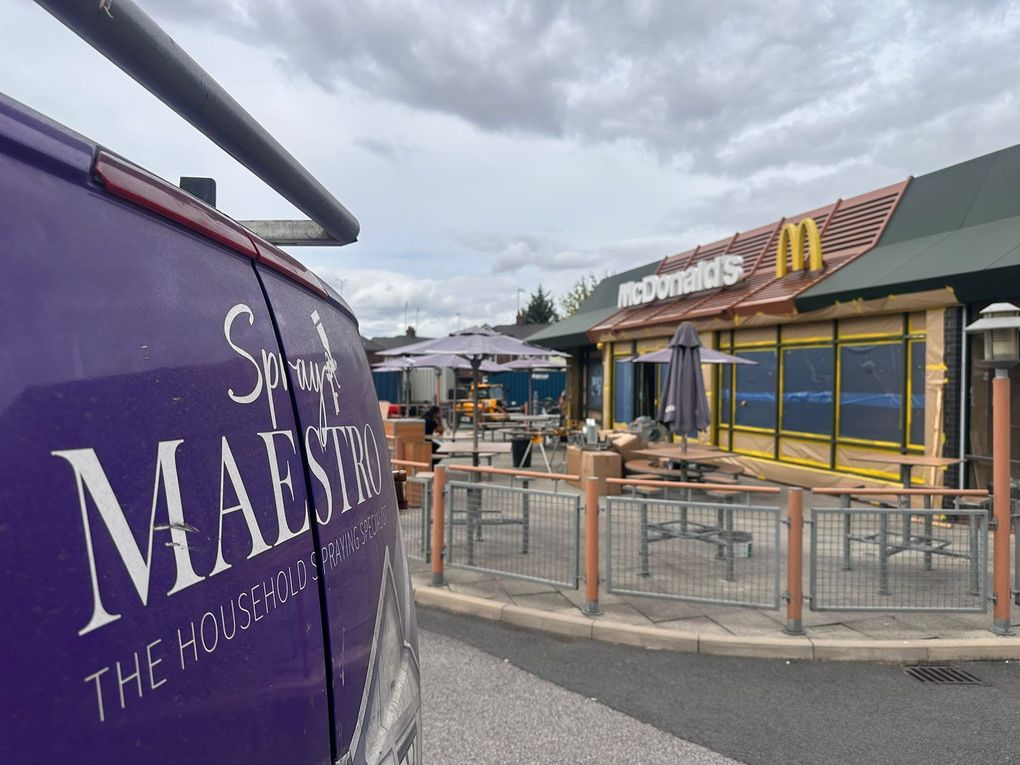
Our first job for a national quick-service restaurant chain took us to Warrington, working for the main contractor on the refurbishment of a trading site. It is outside our usual patch, and exactly the kind of work we want more of.
The photograph at the top of this page was taken during preparation: glazing taped, walls sheeted, the terrace still set out for customers. On a live site like that, the masking is most of the job. Nothing can reach the glass, the signage, the paving or the furniture, and the work area has to stay safe for the public walking past it.
For main contractors and facilities managers, that is the part that matters. We work to your programme and your site rules, supply RAMS and method statements, and carry public and employer’s liability insurance.
Our commercial spray painting services
Commercial work falls into a handful of types, and each has its own surfaces, its own preparation and its own way of fitting around the business. Each type below has a page of its own with the detail.
- Shop fronts
- Restaurants and bars
- Warehouse cladding
- Commercial metalwork
- Office buildings
- Trailers and mobile units
Shop fronts and facades
A shop front is usually several materials pretending to be one: aluminium framing, a timber or composite stall riser, a rendered pier, a sign board and a roller shutter box. Each needs its own preparation and primer, and the whole lot has to come out in one colour. That is where spraying earns its keep over a brush, and where a change of tenant or a rebrand can be done in days rather than waiting on a new frontage.
Most shop fronts are a two-to-three-day job, and the work is planned around trading — over a weekend, on a closed day, or in sections so the door stays open. Our shop front spray painting page covers materials, shutters and signage in full.
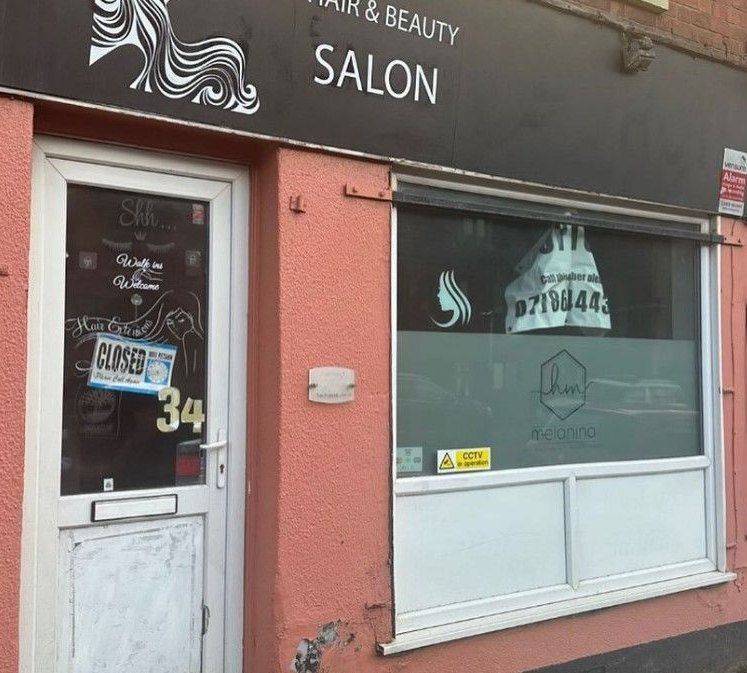
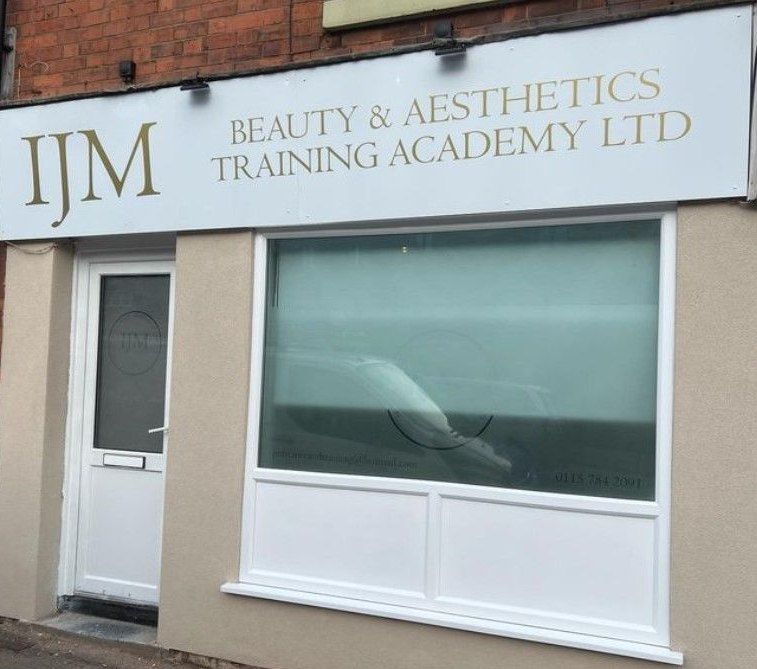
Change of occupant — walls and sign board resprayed ready for the new tenant’s signage.
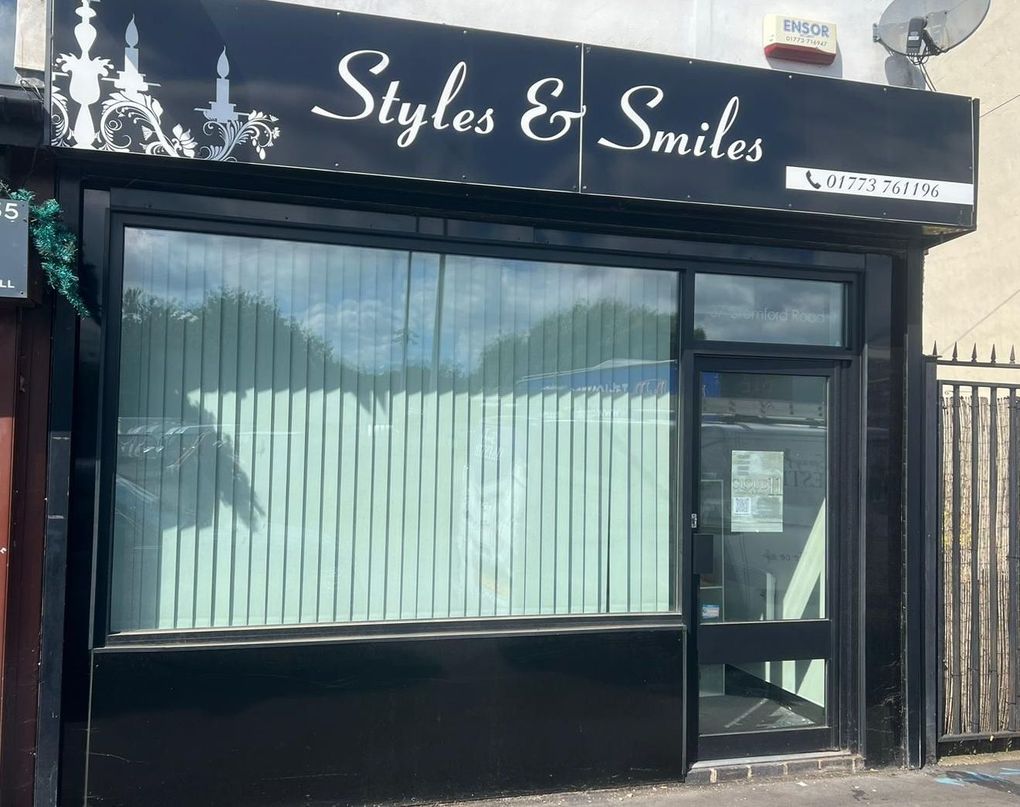
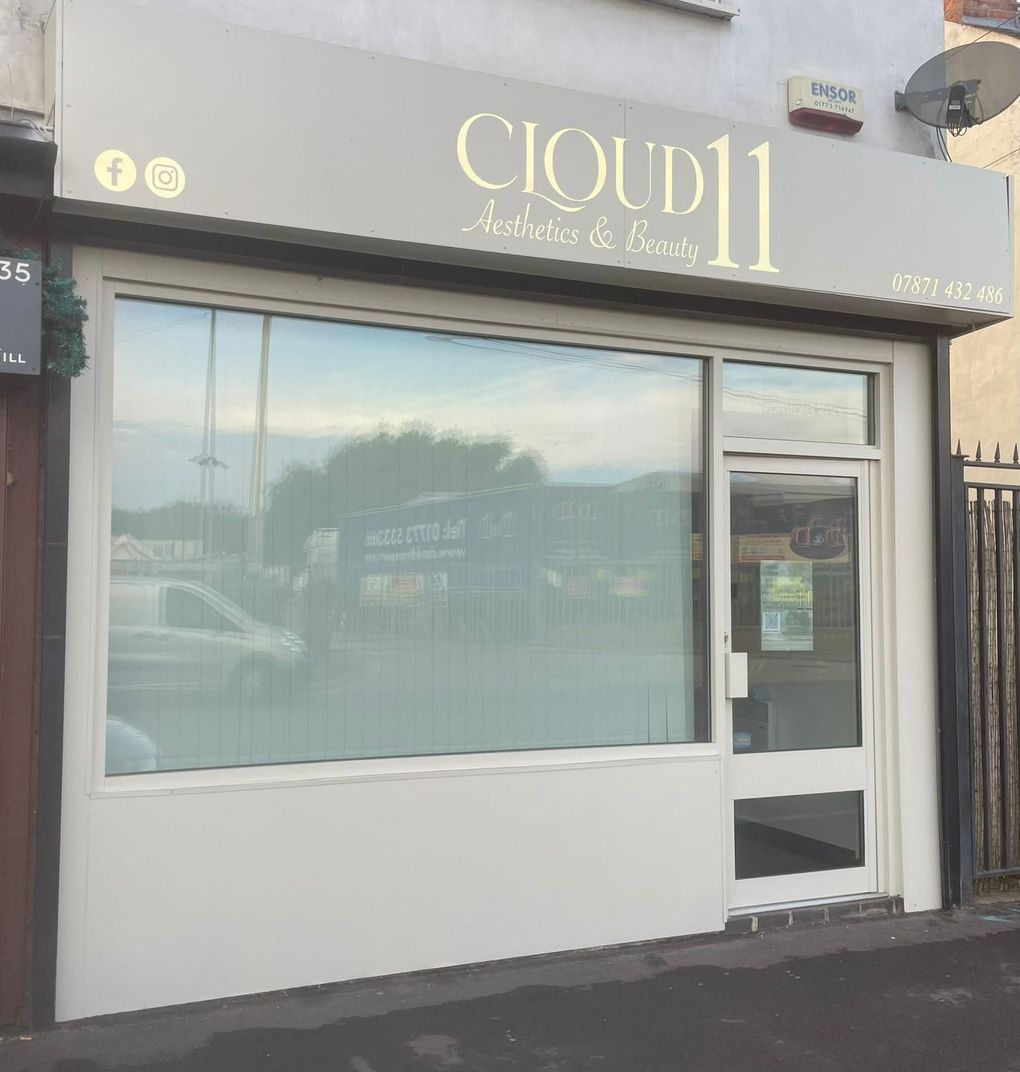
Black to Farrow & Ball Drop Cloth — framing, door and fascia in one colour, so the new name does the work.
Restaurants, bars and cafés
Hospitality venues cannot close for a fortnight while a frontage is redone, and they cannot have customers walking under wet paint. So the work is planned around the trading pattern: closed days, early starts before opening, or a frontage done in sections. On the Warrington job the terrace stayed set out while the building was masked, sheeted and sprayed around it.
Exteriors take the weather; entrances and terraces take the wear, the cleaning and the chairs. Both need a coating chosen for that use, and a brand colour that matches the rest of the group’s sites. More on scheduling, finishes and interiors on our restaurant and bar spray painting page.
Warehouse and industrial cladding
Profiled steel cladding fades and chalks long before it fails. Where the coating has gone but the sheet is sound, respraying restores both the colour and the protection for a fraction of what re-sheeting a building costs. Where rust has started — usually at laps, fixings and the bottom edge — it is taken back and treated with a metal primer before any colour goes on.
Units stay operational while we work, so access is planned around loading bays, vehicle movements and the people using them. The warehouse cladding spraying page goes through panel types, access and corrosion in more depth.
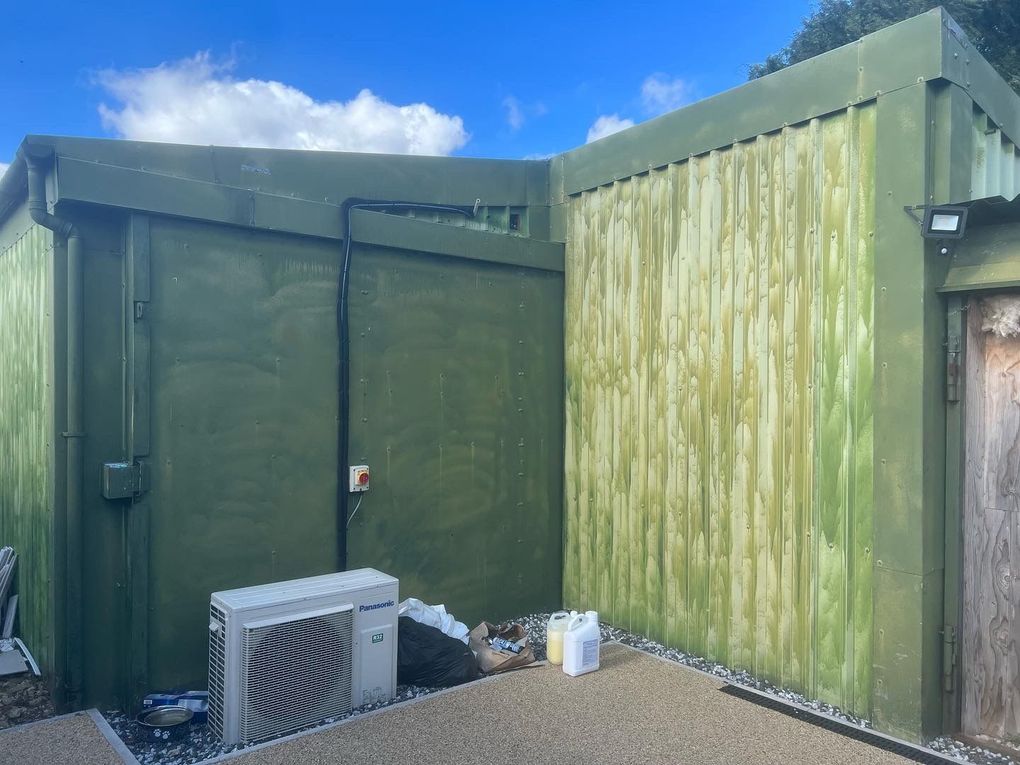
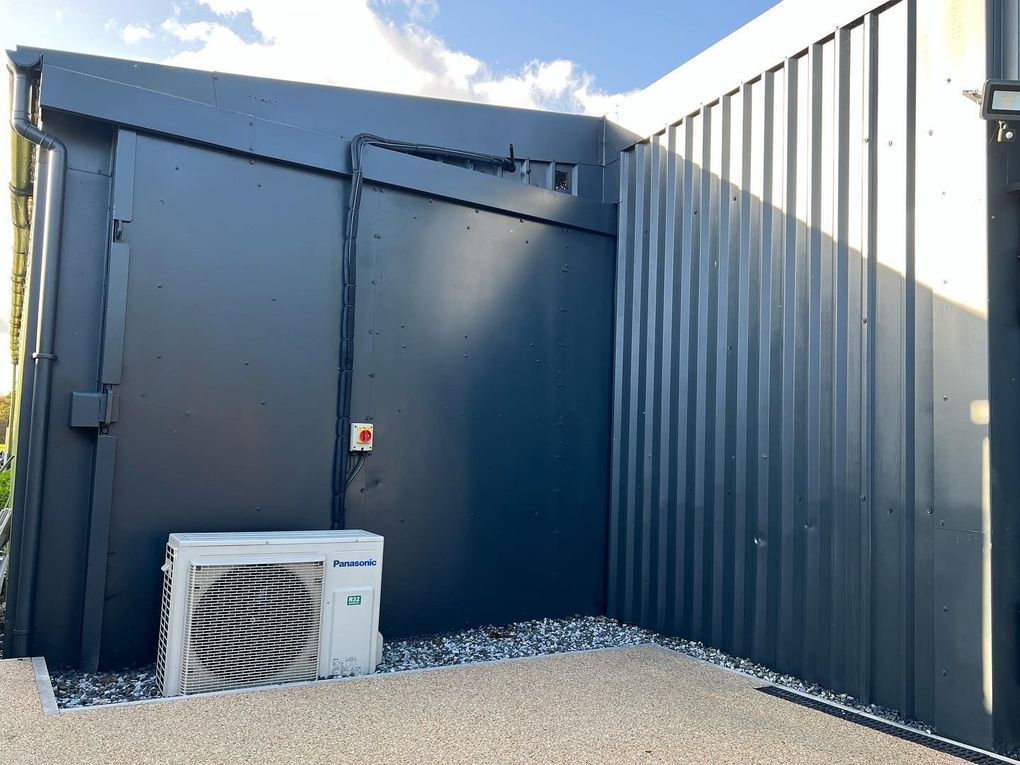
Weathered cladding to anthracite — streaked green panels on a commercial unit, resprayed anthracite grey.
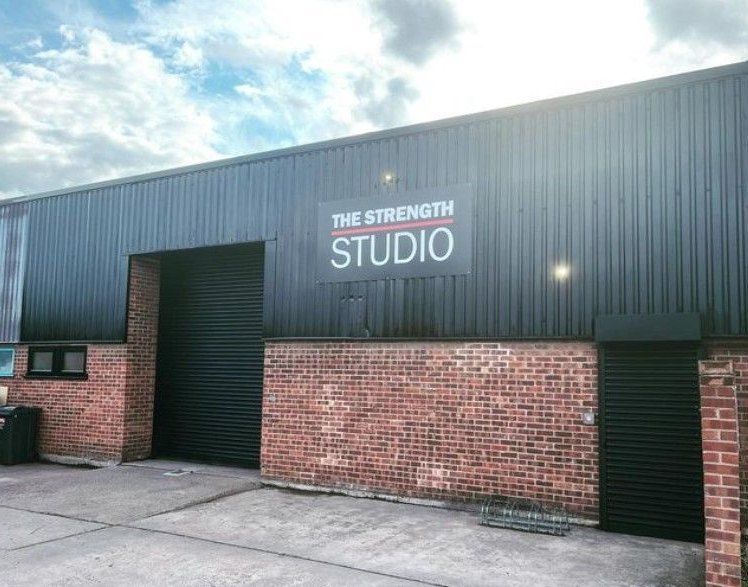
RAL 9005 cladding — a gym’s industrial unit sprayed black to match the colours inside
Commercial metalwork
Railings, gates, fencing, external staircases, balustrades, roller shutters and steel framing all live outside and all rust from the same places: cut edges, welds and anywhere water sits. Metal is the one surface where the preparation decides everything. Loose rust and failed paint are removed, the surface is degreased and keyed, and bare steel gets a primer made for it before the topcoat.
Galvanised steel and aluminium need their own primers again, because an ordinary one will not hold. Our commercial metal spraying page covers substrates, primers and coating build in detail.
Office and commercial buildings
On office buildings and showrooms the work is mostly aluminium: curtain walling, window frames, entrance doors and the trims around them. Occupied buildings mean the work is phased by elevation, entrances are kept open, and the programme is agreed with whoever manages the building and its tenants.
The entrance below is a good example of the detail involved. The doors, frame and handles were sprayed to match the dark grey curtain walling beside them, with the glass sheeted and the render masked. See our office building spray painting page for phasing and multi-tenant work.
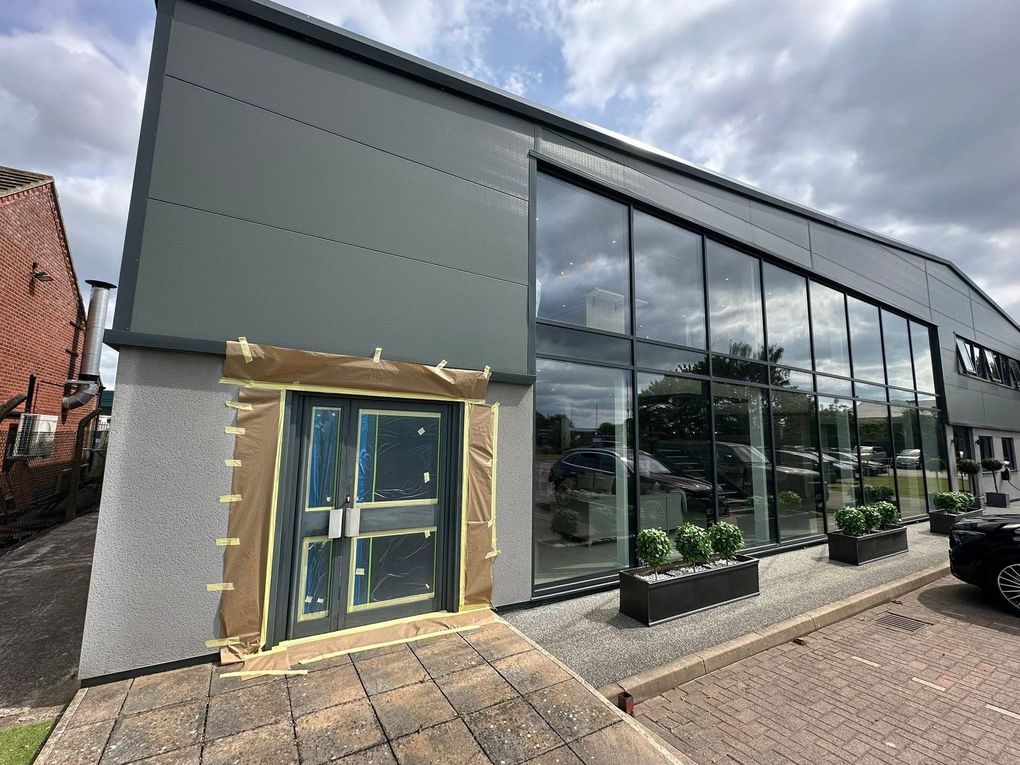
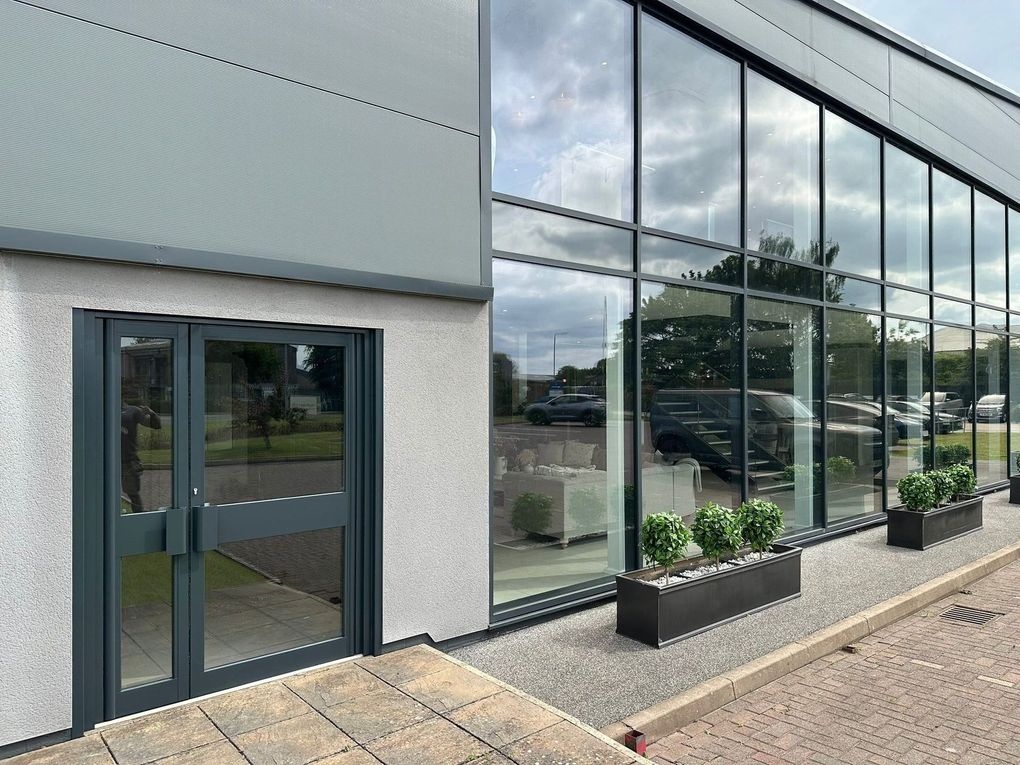
Entrance doors matched to the curtain walling — handles sprayed with the doors, so nothing silver is left to break the line.
Trailers and mobile units
Catering trailers, site cabins and mobile units are metal and composite panels, hatches, trims and fixings, all needing the same colour. They are sprayed where they stand, and the result is a single even finish rather than patched brushwork.
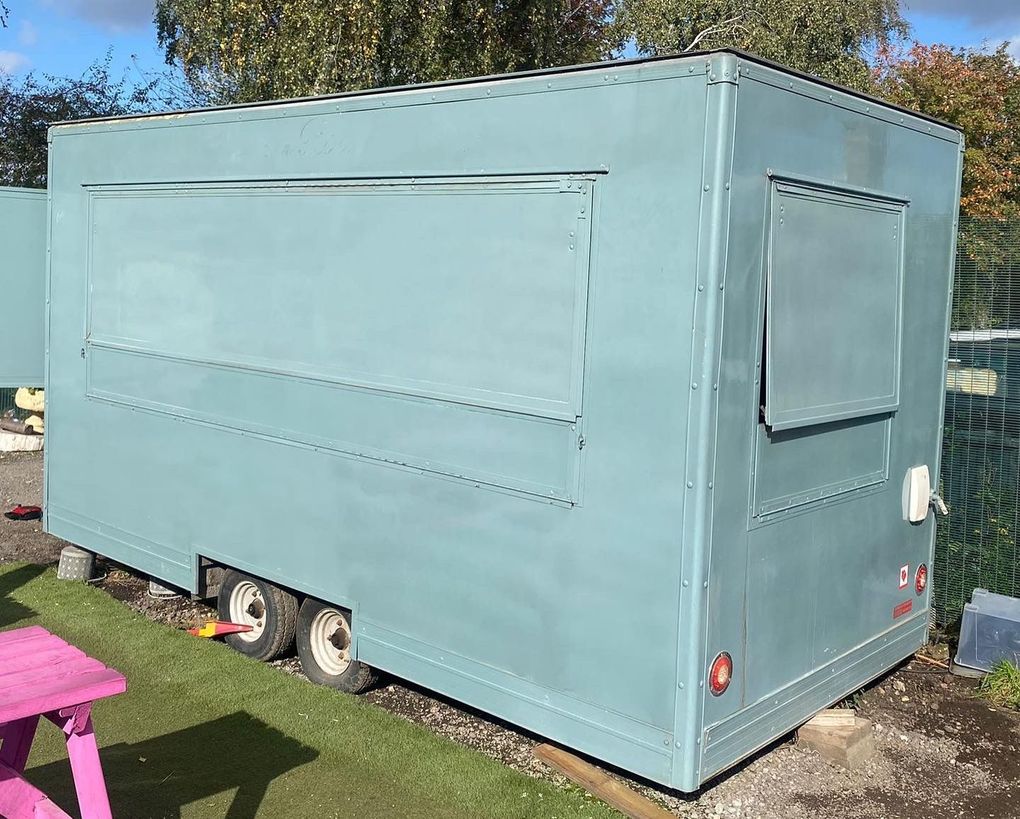
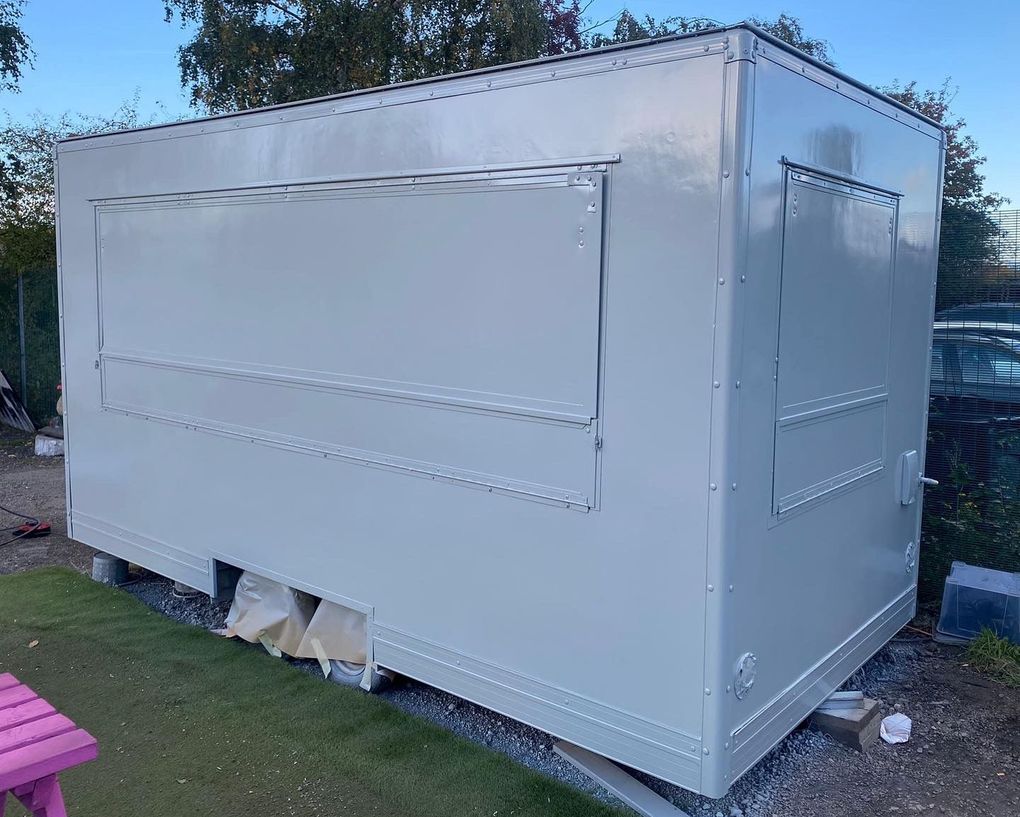
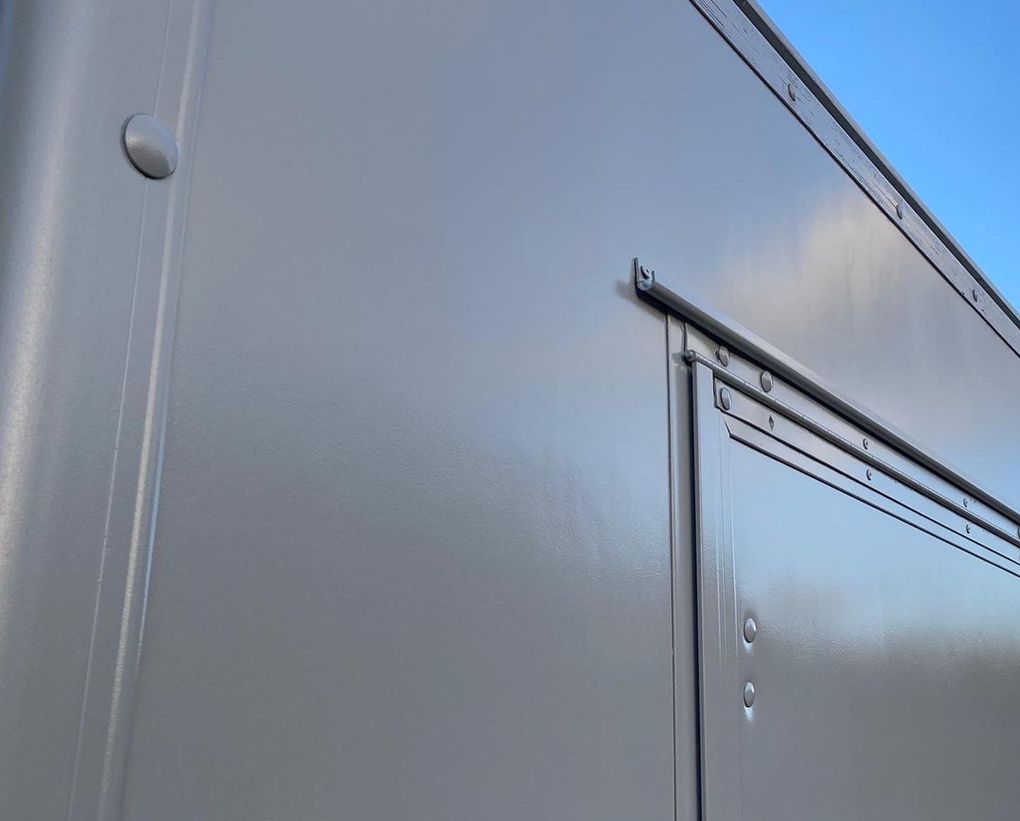
Close up — the finish on the trailer panels
The surfaces we spray
Commercial buildings mix materials, and each one takes paint differently. The preparation and primer are chosen per surface, which is why a frontage that is half aluminium and half timber still comes out one even colour.
- Aluminium Shop front framing, curtain walling, window frames and entrance doors. Cleaned, degreased and keyed, then primed with a primer that bonds to aluminium before the topcoat.
- Steel and profiled cladding Warehouse and unit cladding, shutters and structural steel. Rust taken back at laps, fixings and cut edges, and bare metal primed for corrosion protection.
- Galvanised steel Railings, gates and fencing. Galvanising rejects ordinary primers, so it gets one made for it.
- Timber Traditional shop fronts, stall risers and doors. Filled, sanded and sealed so the grain does not show through the finish.
- uPVC Window frames, panels and fascias on commercial buildings. Cleaned and keyed, with a primer and coating suited to uPVC.
- Render and masonry Piers, walls and plinths around frontages. Cleaned, repaired and sprayed with a masonry coating.
- Composite and mixed frontages Where several materials meet in one frontage, each is prepared for its own substrate so the finished colour is the same across all of them.
Colour matching and brand standards
Brand colours are not approximate. We work from RAL references, Farrow & Ball shades and manufacturers’ corporate palettes, and where a business only has a physical sample — a sign panel, a door, a brochure — we match to that and agree it with you before the full area is sprayed.
Sheen matters as much as colour. Satin, matt and gloss read very differently on a frontage in daylight, so the finish is agreed at the same time as the colour and stays the same from one job to the next.
Working on a live site
Almost all commercial spraying happens while the business around it keeps going. That shapes everything: where the work area is fenced, when the noisiest preparation happens, how deliveries and customers get past, and how long each section is out of use.
On larger sites we work within the main contractor’s programme and inductions, with RAMS and method statements supplied before we start. On smaller ones the business owner gets a straight programme: which days, which hours, and what will be usable when.
More than one site
Businesses with several branches, and landlords with several units, want the same result every time. Once the colour references, sheen and preparation are set on the first job, they are written down and repeated on the next, so a frontage in one town matches a frontage in another.
Who we work for
Commercial enquiries come from a few directions. Independent retailers and salon owners taking on a unit. Restaurant, bar and café operators refreshing a frontage between seasons. Landlords and letting agents getting a vacant unit ready for the next tenant. Facilities and property managers looking after a building or an estate. And main contractors who need a spraying subcontractor on a refurbishment, as in Warrington.
Each wants something slightly different — a date, a price, a colour match or a clean handover — and the quote is written around that.
What decides the cost
Every commercial job is priced individually, because no two frontages are alike. The things that move the figure most are:
- The area to be sprayed, and how much of it is framing against glass. Narrow frames around big panes take more masking than open panels.
- Condition. Faded but sound is quick to prepare. Flaking paint or rust needs taking back first.
- Access and height. Ground-floor frontages need no access equipment. First-floor fascias and cladding runs may need a tower or a platform.
- Extras such as roller shutters, sign boards, canopies and doors.
- When the work happens. Evenings and weekends can carry a premium.
Against replacement, the comparison is usually straightforward. Replacing a frontage means manufacture, lead time, fitting and disposal. Respraying keeps what is sound and changes the finish, and it is normally done in days. Photographs are often enough for a provisional figure.
How a commercial job runs
-
Photos first
Send the address, a few photographs and rough measurements if you have them. For many shop fronts that is enough for a provisional figure before anyone travels.
-
Survey and written quote
We look at the surfaces, the access and the site rules, then confirm the preparation, coatings, programme and guarantee terms in writing.
-
Programme
The work is fitted around trading — closed days, evenings or weekends where the site needs it. Out-of-hours working can carry a premium, and the quote says so if it does.
-
Preparation
Clean, degrease, key and repair. Everything not being sprayed is masked and sheeted, and bare or awkward substrates are primed.
-
Spraying
Thin coats, built up with proper drying time between them, rather than one heavy coat that runs or stays soft.
-
Handover
We inspect the work with you, strip the masking and leave the site clean, with the products used and the guarantee terms confirmed in writing.
Where we work
Regular commercial work across
- Nottingham
- Derby
- Leicester
- Mansfield
- Newark
- Sutton-in-Ashfield
- Ilkeston
- Loughborough
- Ashby-de-la-Zouch
- Coalville
- Grantham
- West Bridgford
- Beeston
- Arnold
- Bulwell
We are based on Aspley Lane in Nottingham, and commercial work across Nottinghamshire, Derbyshire, Leicestershire and Lincolnshire is routine for us.
Further afield, we take work on its merits. The size of the job and the distance to it decide it, so the quickest way to get an answer is to send the address, a few photographs and a rough idea of the area involved. Warrington was the first of these. If your site is further than that, ask anyway.
Guarantee and aftercare
Commercial work carries the same 10-year guarantee as our residential work. The terms are confirmed in writing with the quote, and at survey we look at how exposed each surface is — a sheltered office entrance and an industrial unit facing a main road do not wear the same way — so the coating is chosen to last the full ten years.
A sprayed finish lasts longest when it is cleaned with a soft brush or cloth and a mild detergent, not a pressure washer at close range or anything abrasive. Scuffs and knocks on a busy entrance can be touched in without respraying the whole elevation, and we will tell you at handover what to use and what to avoid.
The guarantee covers adhesion and the integrity of the finish under normal use. It does not cover impact damage, vandalism, or alterations made to the sprayed surfaces afterwards.
Commercial spray painting questions
Do you take commercial work outside the East Midlands?
Yes, job by job. The size of the job and the distance to it decide it. Our first job for a national quick-service restaurant chain was in Warrington, working for the main contractor. Send the address and a few photographs and we will tell you quickly whether it works.
Can you work as a subcontractor to a main contractor?
Yes. We work to the contractor's programme and site rules, supply RAMS and method statements, and carry public and employer's liability insurance.
Can you work around our trading hours?
Yes. Commercial work is regularly programmed for closed days, evenings or weekends so the business keeps trading. Out-of-hours working can carry a premium, and the quote says so if it does.
How long does a commercial respray take?
A single shop front typically takes two to three days, including preparation, priming and drying time between coats. Larger jobs such as office exteriors or warehouse cladding can run to one or two weeks. The survey confirms the programme for your site.
Can you match our brand colours?
Yes. We work from the full RAL range, Farrow & Ball shades and corporate palettes, so the frontage matches your brand guidelines and your other sites.
How much does it cost to respray a shop front or cladding?
It depends on the area, the amount of framing against glass, whether shutters and sign boards are included, and access. Every commercial job is quoted individually, and photographs are often enough for a provisional figure before a survey.
What paint do you use?
Water-based coatings chosen for the surface: metal, aluminium, timber, render and uPVC each get the primer and finish that suits them. Water-based paints carry fewer solvents than oil-based ones and suit occupied sites.
Send us the address and a few photos
Tell us what needs spraying and when the site can have us. We will come back with a provisional figure or a survey date.