Can You Spray Paint UPVC Windows Yourself? Honest DIY vs Pro Guide

DIY UPVC painting
Yes — you can spray paint UPVC windows yourself, but the results rarely match a professional finish. With the right specialist paint, thorough surface preparation, and careful masking, a DIY respray is achievable. However, the margin for visible error is slim, the equipment costs are significant, and a poor result can be harder to fix than starting from scratch. This guide gives you an honest picture of both routes so you can make the right call for your home.
The honest answer first
Most guides written by spray painting companies will tell you that DIY is a disaster and you should always hire a professional. We're not going to do that. The truth is more nuanced — and if you're a capable DIYer with patience and the right materials, a single window or door can be resprayed to a decent standard at home.
Where DIY typically falls down is scale, consistency, and longevity. Spraying one front door is very different from respraying an entire house of windows to a uniform finish. And even a single surface done poorly can look worse than the original discolouration you were trying to fix.
So here is what you actually need to know before you decide.
What DIY UPVC spraying gets right
Let's be fair about what is achievable at home before we get into the limitations.
- Small, contained jobs. A single front door or one or two windows on a ground floor are the most manageable DIY candidates. The masking area is limited, access is easy, and any inconsistency is contained to a small surface.
- Colour refreshing rather than full colour changes. If your UPVC has faded but you want to stay close to the original white or cream, a brush-on UPVC paint (rather than spray) can deliver acceptable results with less equipment and less overspray risk.
- Cost at small scale. For a single window or door where you are happy with a good-enough rather than perfect result, DIY materials can cost as little as £20–£40 for brush-on paint, versus £75–£160 for a professional spray.
- Satisfaction and control. Some homeowners simply prefer to do things themselves, and for low-visibility or internal surfaces, that is a completely reasonable choice.
Where DIY UPVC spraying falls short
This is where most guides skip straight to a sales pitch. We'll be specific instead.
The paint itself
Standard aerosol paints, fence paints, and even most trade paints will not bond properly to UPVC without a specialist adhesion primer formulated for plastics. Without it, the paint will peel, bubble, or flake — sometimes within weeks. The specialist paints Spray Maestro uses are two-part coatings designed for flexible plastic substrates. They are not widely available in DIY stores, and when you do find them, they are not cheap.
Surface preparation
Professional UPVC spraying involves a multi-stage preparation process: degreasing with a specialist solvent cleaner, light abrading to create a key, priming, and full masking of glass, seals, handles, and surrounding brickwork. Skipping or rushing any of these stages is the single biggest cause of DIY UPVC paint failures. It is also the most time-consuming part of the job — often taking longer than the spraying itself.
Spray equipment
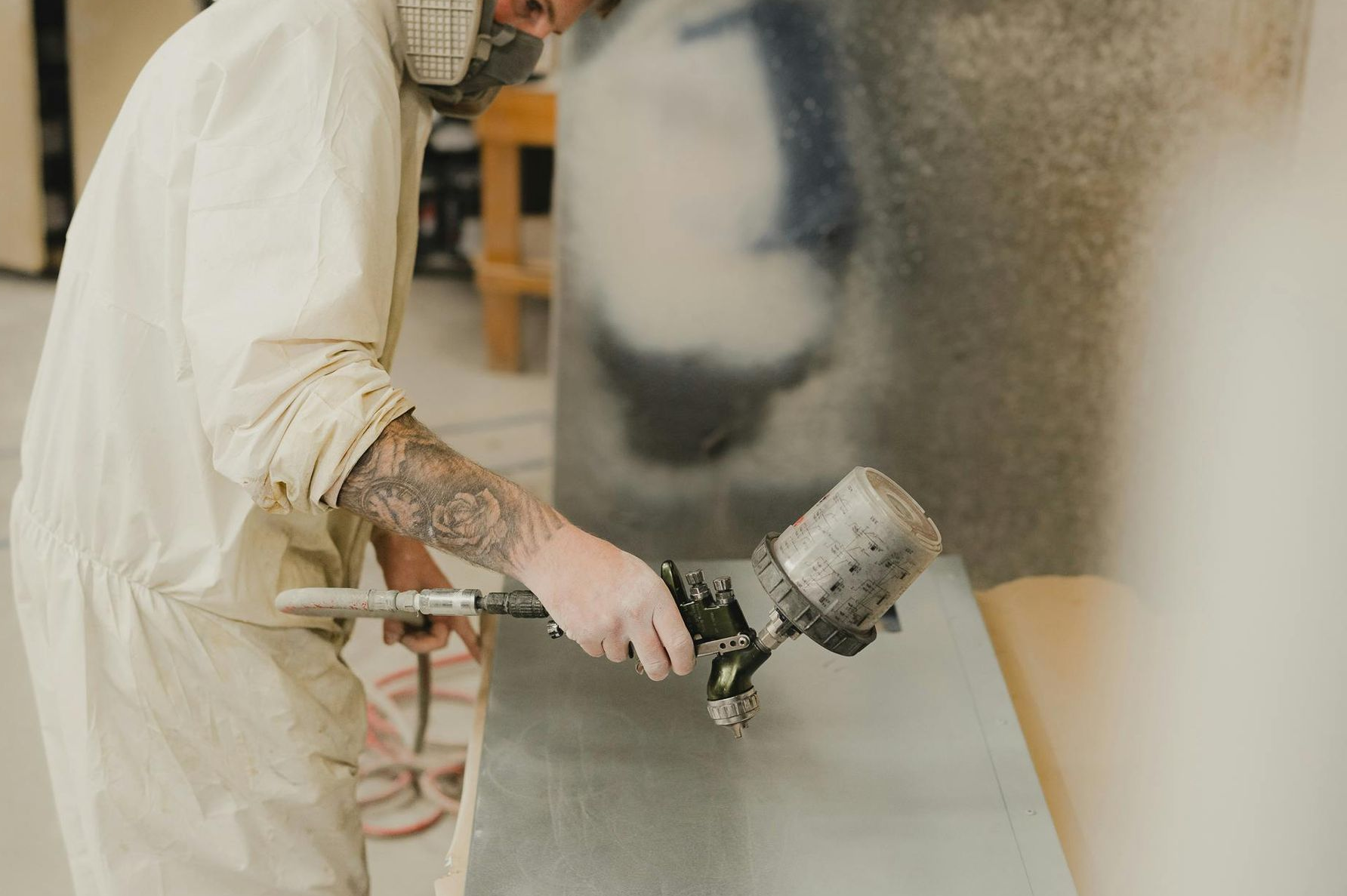
To achieve the smooth, even finish that makes a UPVC respray look factory-applied, you need an HVLP (high-volume, low-pressure) spray system, not an aerosol can. A decent HVLP setup costs £150–£400 to buy, or roughly £40–£80 per day to hire. Add in the compressor, spray gun cleaning, and the learning curve for consistent technique, and the cost and effort quickly mount up for a one-off job.
Overspray and masking
One of the most common DIY mistakes is underestimating how far fine spray mist travels. Glass, frames, brickwork, plants, and parked cars can all pick up overspray if the masking is not thorough. Professional sprayers use full enclosure techniques and low-pressure equipment specifically to control this. On a windy day outdoors, overspray risk increases significantly.
Consistency across a whole house
Even experienced DIYers find it extremely difficult to achieve a uniform finish across multiple windows on the same property. Slight variations in technique, paint dilution, or temperature between coats can result in visible colour or sheen differences when the light catches the surface — something that is immediately noticeable on a large exterior.
Honest verdict
DIY UPVC spraying is achievable for small, low-visibility jobs where a near-professional result is acceptable. For anything involving multiple surfaces, a colour change, or a prominent exterior like a front door or full house of windows — the preparation time, equipment cost, and risk of a poor finish make professional spraying significantly better value.
DIY vs professional UPVC spraying — side by side
see our full pricing guide for all surfaces.
DIY spraying
- Materials from ~£20–£150+
- Equipment hire ~£40–£80/day
- Full day+ preparation required
- High risk on large or prominent surfaces
- No guarantee on longevity
- Difficult to achieve consistency
- Mistakes can be hard to reverse
Professional Spraying
- Windows from £75 · doors from £160. See our full pricing guide for all surfaces.
- All equipment and materials included
- Full preparation handled for you
- Consistent finish across all surfaces
- 10-year guarantee as standard
- Specialist two-part UPVC coatings
- Free quote, no obligation
If you decide to do it yourself — do it properly
If you've weighed everything up and want to give it a go, here is the correct process. Skipping steps is where most DIY UPVC paint jobs fail.
Use the right paint
Only use a paint specifically formulated for UPVC or flexible plastics. Look for products labelled as direct-to-plastic or two-part UPVC coatings. Avoid standard masonry, wood, or gloss paints entirely.
Clean and degrease thoroughly
Wash the surface with sugar soap or a dedicated UPVC cleaner to remove dirt, grease, and mould. Then wipe down with an isopropyl alcohol (IPA) solution to remove any remaining residue. Allow to dry completely.
Lightly abrade the surface
Use a fine-grit abrasive pad (320–400 grit) to lightly scuff the UPVC. This creates a mechanical key for the paint to bond to. Wipe away dust with a tack cloth before proceeding.
Apply adhesion primer
A specialist adhesion or etch primer for plastics is not optional — it is what makes the difference between paint that lasts and paint that peels. Apply a thin, even coat and allow full drying time as per the manufacturer's instructions.
Mask everything thoroughly
Tape off all glass, rubber seals, handles, hinges, and surrounding brickwork with low-tack masking tape and paper or film. Take your time here — overspray on glass is difficult to remove cleanly.
Apply thin, even coats
Whether brushing or spraying, apply multiple thin coats rather than one thick coat. Allow each coat to tack off before applying the next. Thick single coats sag, run, and dry unevenly on UPVC.
Leave adequate curing time
UPVC paints typically require 24–48 hours before they are fully hardened, even when dry to the touch. Avoid cleaning or touching the surface during this period to prevent marking.
A note on brush vs spray at home:
For most DIYers, a quality brush or foam roller will give more controllable results than a cheap aerosol or entry-level spray gun. The finish will not be as smooth as professional spraying, but it will be more consistent than a poorly handled spray setup. Save the spray equipment for when you are confident in your technique.
When it's worth calling a professional instead
There are some situations where the DIY route is not the right one, regardless of skill level:
- More than two or three windows — achieving a consistent colour and sheen match across multiple surfaces is very difficult without professional equipment and technique.
- A prominent front elevation — your front door and street-facing windows are the most scrutinised surfaces on your home. This is not the place to experiment.
- A significant colour change — going from white to anthracite grey, for example, requires multiple coats with specialist coatings to achieve full, even coverage. The margin for streaking or patchiness is high.
- A conservatory or large glazed structure — the masking complexity alone makes this a professional job in most cases.
- You want a result that lasts — a professional finish backed by a 10-year guarantee is a fundamentally different proposition to a DIY result with no guarantee of longevity.
For any of the above, a free quote from Spray Maestro will typically show that professional spraying costs less than the materials, equipment, and time a DIY attempt would consume — with a significantly better outcome. For anything more than a single low-profile surface, our full spraying price guide will typically show that professional spraying costs less than the materials and time a DIY attempt would consume.
For anything involving more than two or three windows,
professional UPVC window spraying delivers a consistent finish across every surface that DIY equipment simply cannot replicate.
Frequently asked questions
Can I use normal paint on UPVC windows?
No. Standard paints — including gloss, masonry, and most aerosols — will not bond permanently to UPVC without a specialist adhesion primer, and even then may not last. You need paint specifically formulated for UPVC or flexible plastic substrates.
What is the best paint for UPVC windows?
The best results come from two-part polyurethane coatings designed for flexible plastics, applied over a specialist adhesion primer. These are not typically available in high-street DIY stores. For a single window or door, some single-part UPVC paints from specialist suppliers can give acceptable results if the surface preparation is thorough.
How long does DIY UPVC paint last?
This varies enormously depending on the paint used, surface preparation, and application method. DIY results can last anywhere from 1–2 years with basic products and preparation, to 5+ years with professional-grade materials and a thorough process. Professional spray painting backed by a 10-year guarantee is a very different proposition.
Is it worth paying someone to spray UPVC windows?
For most homeowners — yes. Professional UPVC spraying starts from £75 per window with Spray Maestro, includes all materials, preparation, and a 10-year guarantee, and typically takes less time than a DIY attempt on even a single surface once preparation is factored in. For anything more than a single low-profile surface, the professional route nearly always represents better value.
Can you spray UPVC windows in winter?
Cold temperatures affect both adhesion and drying times for UPVC paints. Professional sprayers use climate-appropriate coatings and will not spray below certain temperature thresholds. DIY spraying in cold or damp conditions significantly increases the risk of a poor result.
Will spray painted UPVC windows peel?
Professionally applied UPVC coatings, using the correct primer and two-part paint system, should not peel for many years. DIY results are more variable — peeling is most commonly caused by inadequate surface preparation, using the wrong paint type, or applying coats that are too thick.
Not sure which route is right for you?
Send us photos of your windows, doors, or surfaces and we'll give you an honest assessment and a free, no-obligation quote — usually within 24 hours.